
Climate Facts I Didn’t Know
“A Critical Review of Impacts of GHG Emissions on the US Climate” (Hereafter CRI) is an account of the consequences of climate change by five critics of the current orthodoxy; its sponsorship by the Department of Energy is evidence that the Federal Government has now switched sides on the climate controversy. I have been criticizing the current orthodoxy for almost twenty years, devoted many of my early posts here and on my blog to the subject, so was interested in what professionals on my side of the argument would have to say.
Some of the points in CRI were things that I was already aware of, others were not. This post is about the latter.
Ocean pH
In my first Substack post I tried to estimate the net externality from climate change, positive externalities minus negative externalities. The predictable consequence whose cost I found it hardest to get a handle on was the effect of the reduction in ocean pH due to the absorption of CO2, commonly but misleadingly referred to as acidification.1
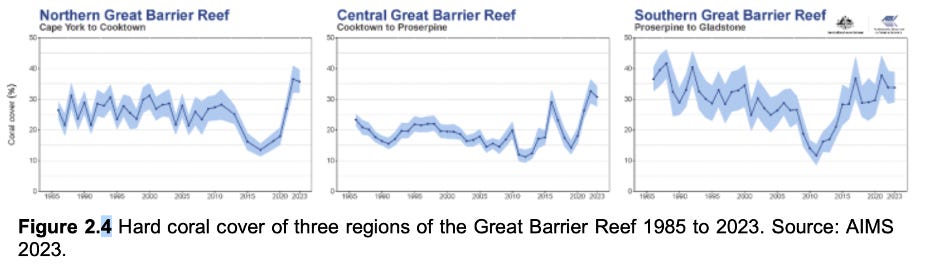
CRI helps fill that hole in my argument in two ways. First, it reports that the evidence of bad effects from decreased pH is weak. Apparently the Great Barrier Reef, supposedly damaged by climate change, has at this point entirely recovered.
And the earlier reports of effects of pH on reef fish behavior may have been mistaken or at least exaggerated:
[The] vast majority of studies with large effect sizes in this field tend to be characterized by low sample sizes, yet are published in high-impact journals and have a disproportionate influence on the field in terms of citations. We contend that ocean acidification has a negligible direct impact on fish behavior, and we advocate for improved approaches to minimize the potential for a decline effect in future avenues of research (Clements et al., 2021).
In a field as controversial as climate change, the conclusion of a scientific article, such as that quote, cannot be taken on faith. I have found multiple examples of work published in reputable sources that I believe I can show to be either dishonest or at least indefensibly biased. The examples I have discovered are all on the side of the climate argument I oppose, that being where I have looked for them, but there is no reason for me to assume, certainly no reason for my readers to assume, that similar things do not exist on my side. It follows that in order to rely on a claim such as that in the quote I would have to read enough of the literature to be reasonably confident that its claims were true. I have not done so.
Fortunately, CRI offers a second piece of evidence which while relevant to the climate controversy does not originate as part of it, so can probably be trusted:
On the time scale of thousands of years, boron isotope proxy measurements show that ocean pH was around 7.4 or 7.5 during the last glaciation (up to about 20,000 years ago) increasing to present-day values as the world warmed during deglaciation (Rae et al., 2018).
Looking at Fig 1 in the quoted article, pH rises from 7.4 nineteen thousand years ago to 7.87 eleven thousand years ago, declines to 7.76 nine thousand years ago, rises to 7.9 six thousand years ago. It is currently 8.04 and falling by about .017/decade. If it has been going up and down that routinely it is unlikely that the current gradual decrease will have drastic effects.
Furthermore:
The Great Barrier Reef Marine Park Authority (GBRMPA) considers the earliest evidence of complete reef structures to have been 600,000 years ago. According to the GBRMPA, the current, living reef structure is believed to have begun growing on the older platform about 9,000 years ago. (Wikipedia)
If the current living reef structure began growing when ocean pH was 7.76 it is hard to see how it could have been destroyed by pH falling to 8.04 due to the effect of human production of CO2.
I conclude that the reduction in the pH of the ocean is unlikely to constitute a significant externality of climate change.
Moore, Rennert, and McKittrick
One of my earlier posts was a detailed criticism of Rennert et al. 2022, an article that claimed to estimate the social cost of carbon summed from now to 2300. About half its total was for the effect of climate change on agriculture, based on a metastudy by Moore. In my piece I offered some criticisms of it, concluding that:
Correcting the neglect of technological change and using a more realistic value for CO2 fertilization would reduce Moore’s estimate substantially, might make the net effect of climate change on agriculture positive.
It now turns out that a recent article by one of the coauthors of CRI, McKitrick 2025, reanalyzes the data collection for Moore’s metastudy, reversing the conclusion:
McKitrick (2025) re-examined the Moore et al. database and found that, while it claimed to cover 1,722 studies, only half the entries (N=862) had complete records, so that the sample available for regression analysis was much smaller than both studies indicated. McKitrick noted that the records most commonly missing were the changes in ambient CO2 and found that in many cases these could be recovered from the underlying studies or the original climate scenario tables, thereby increasing the usable sample size by 40 percent. The crop yield projections incorporating the newly available data changed considerably. As shown in Figure 9.2, whereas the partial data set implied warming would decrease yield (blue lines), the complete data set implied constant or increase global yields, even out to 5°C warming (green lines).
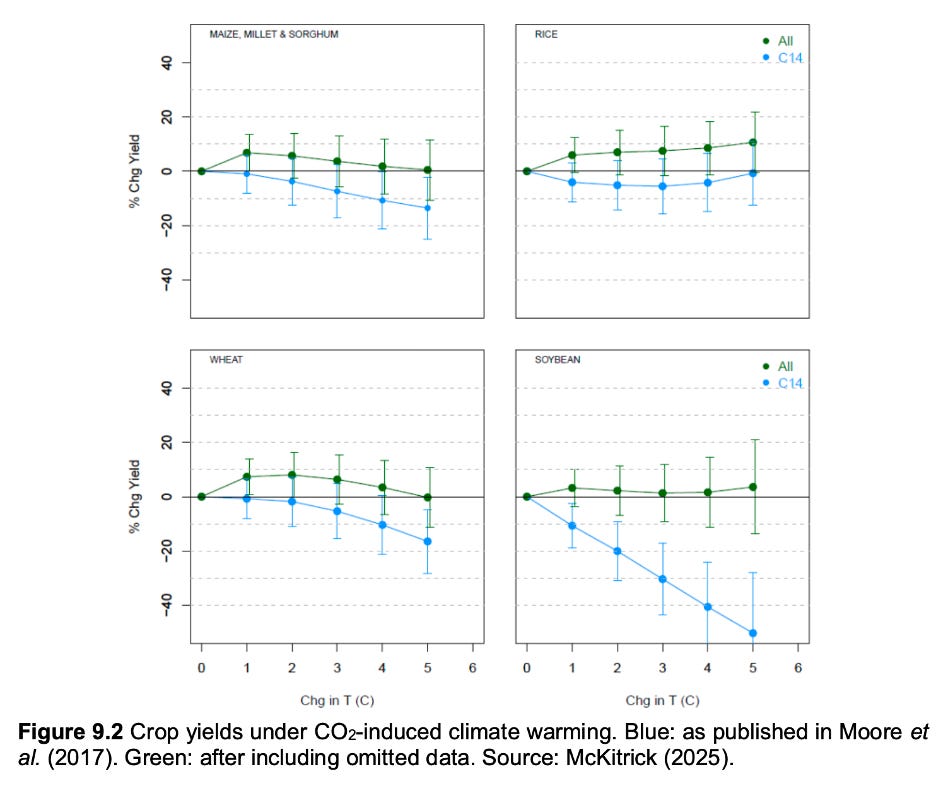
If that is correct — I have emailed Moore to ask if she has published or is publishing a rebuttal — it eliminates about half the cost of carbon estimated in Rennert.
Most of the rest is from increased mortality due to warming. In my critique I offered several criticisms of that calculation, most notably that it depended on the implicit assumptions that there would be no medical progress for the next three centuries and that increases in income — about ten-fold by the end of their period — have no effect on vulnerability to heat and cold. CRI cites evidence that supports that criticism:
Davis et al. (2003) examined heat-related mortality in 28 U.S. cities from the 1960s to the end of the 1990s and found that heat-related mortality declined by three-quarters over the sample period. Bobb et al. (2014) examined mortality data for 106 million people in over 100 cities U.S. cities and found a 60 percent decline in average heat-related mortality over the period 1987—2005, from 51 per thousand deaths to 19. They furthermore found that the greatest drop was among seniors over the age of 75. In a study of 42 million deaths in 211 U.S. cities from 1962 to 2006. Nordio et al. (2015) found a more than 90 percent decline in the risk of mortality from excess heat.
Other Things
CRI contains a good deal of other material relevant to the climate controversy, including
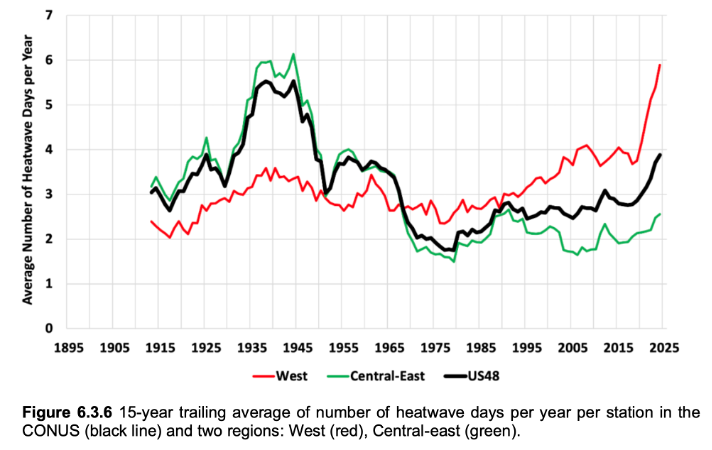
The comparison of long-term vs short-term trends in climate. The 3, 5, and 14-day records for rainfall in San Francisco from 1895 to 2024 are all 2023, the thirty-day record is 1998, which looks like a trend towards greater rainfall. Push the range back to 1850 and 3-day and 5-day records are 1867, the 14-day and 30-day records are 1862.
Similarly, the fact that the number of heat wave days in the US has increased each decade since 1960 looks like evidence of a trend, was represented as such on a website2 pointed at by the NCA5 —
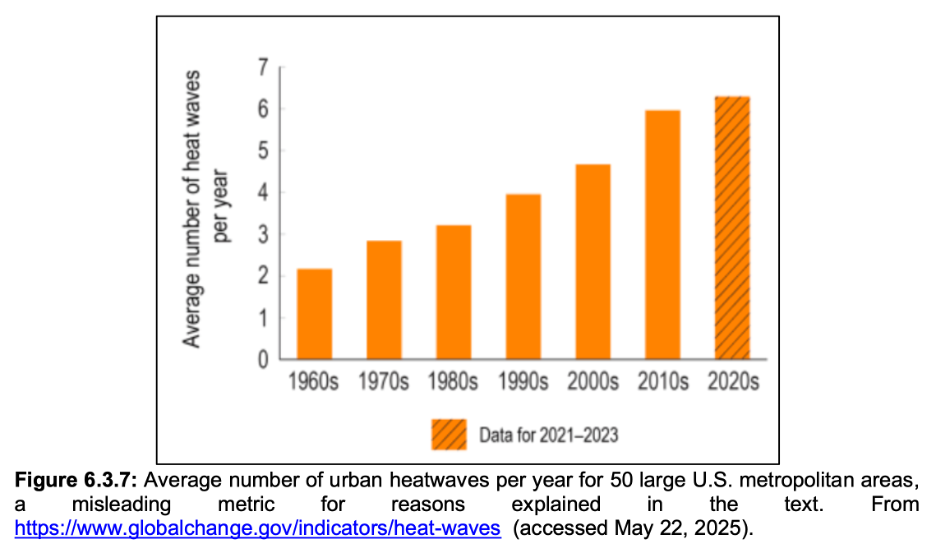
misleadingly:
IPCC Modesty
CRI contains a number of examples of the IPCC report failing to support claims of the broader climate movement. Of 33 potential effects of anthropogenic climate change on humans, the IPCC asserts evidence of anthropogenic cause with high confidence for only five (mean air temperature, extreme heat, lake, river and sea ice, mean ocean temperature, and atmospheric CO2 at surface) and with medium confidence for four more (less frequent cold spells, less permafrost, greater ocean salinity and less dissolved oxygen). They do not claim any anthropogenic signal in, among other things, mean precipitation, heavy precipitation, river, coastal and pluvial flood, aridity, drought, fire weather, or tropical cyclones.
And, for another example of IPCC modesty, from the Fifth Assessment Report:
For most economic sectors, the impact of climate change will be small relative to the impacts of other drivers. Changes in population, age, income, technology, relative prices, lifestyle, regulation, governance, and many other aspects of socioeconomic development will have an impact on the supply and demand of economic goods and services that is large relative to the impact of climate change.
Which is not consistent with the catastrophist claims common in the media and political rhetoric.
Conclusion
There is a lot more in CRI. Some I have not covered because I already knew it, some offering evidence that the future path of climate change and its consequences are much more uncertain than the IPCC claims. This is a conclusion I agree with — I have long argued that we not only do not know the size of the net externality from anthropogenic warming we do not even know its sign.
It is a document that anyone seriously interested in climate issues should read, critics of the current orthodoxy to find better arguments for their side, supporters to see the best arguments against theirs.
Past posts, sorted by topic
My web page, with the full text of multiple books and articles and much else
A search bar for text in past posts and much of my other writing
The label, while technically correct, is misleading because the ocean is basic (pH 8.04). Lowering its pH moves it towards neutral (pH 7.0). Lowering it past 7 would make it acidic but, at the current rate of change, that would take about six centuries.
The page is no longer up; the link is to a copy in the internet archive from June 30 of this year.
"Looking at Fig 1 in the quoted article, pH rises from 7.4 nineteen thousand years ago to 7.87 eleven thousand years ago, declines to 7.76 nine thousand years ago, rises to 7.9 six thousand years ago. It is currently 8.04 and falling by about .017/decade. If it has been going up and down that routinely it is unlikely that the current gradual decrease will have drastic effects."
I don't disagree with your overall skepticism, but your logic here is sloppy. A (7.87-7.4)/(19k-11k years) pH change is 0.0007 pH per decade, orders of magnitude slower than 0.017/decade currently.
There was an alternative explanation for the Great Barrier Reef's decline - phosphate runoff from agricultural fertilisers. And when the government cracked down on that, the reef recovered...