
False Positives
their use
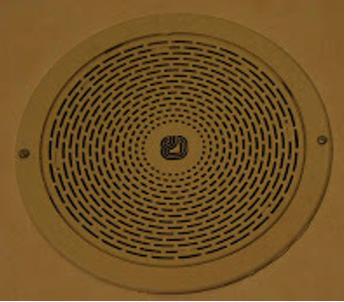
The picture above1 shows a series of concentric circles. As I look at it, I see other patterns. With only a little effort, it turns into a series of clockwise spirals. Or counter-clockwise spirals. Or … . It feels as if my internal software is thrashing around, trying out one pattern after another.
Human beings are equipped with pattern recognition software so good that it can find patterns that are not there. That makes sense from an evolutionary point of view. Seeing a hidden tiger that is not actually there is a much less costly mistake than failing to see one that is there, so biasing the software in the direction of more of the first kind of error and fewer of the second, fewer false negatives and more false positives, is good design.
I see the same thing looking at the six digit numbers sent to my email in the process of checking that it is really mine. They are presumably random but don’t look random. Pulling ten out of my email trash:
587150, 795723, 066684, 288355, 492324, 680809, 170602, 208328, 830373, 223445
I have bolded the ones that appear to have a pattern. If the last was the number for your combination lock, cell phone security key or password it would be easy to remember.
That bias in our software may help to explain the popularity of conspiracy theories believed on inadequate evidence. Constellations.
Hamlet: “Do you see yonder cloud that’s almost in shape of a camel?”
Polonius: “By the mass, and ’tis like a camel, indeed.”
Hamlet: “Methinks it is like a weasel.”
Polonius: “It is backed like a weasel.”
Hamlet: “Or like a whale?”
Polonius: “Very like a whale.”
Perhaps also religions.
The Use of False Positives.
Numbers can be seen, thought of, in different patterns. One is the counting pattern, exemplar 12345678. If that is a pattern you see numbers in the last of the ten listed above should be easy to remember. Other patterns work for others of the six digit sequences but less well, repeated digits (third and fourth above), repeated runs (fifth). A mind prone to see patterns can remember a number by finding a pattern in terms of which it is memorable and linking it to that pattern. In the same way, someone familiar with several languages could remember a sequence of letters created randomly for a password by finding a word in some language related to it — the password itself, the password backwards, the password with one letter changed.
A real example that started me thinking along these lines.
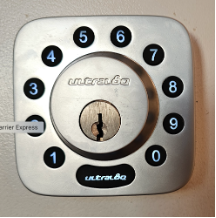
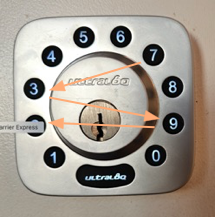
I was recently staying in a room that unlocked with a four digit number entered on a circular keypad, shown above. The number was 7392. The digits alternate between sides of the circle, the second of the pair on the left larger by two than the first on the left, the second of the pair on the right larger by one than the first on the right. With a little effort that felt like a pattern, easier to remember than four unrelated digits. All I had to remember was the first digit and the pattern.
My web page, with the full text of multiple books and articles and much else
Past posts, sorted by topic
A search bar for past posts and much of my other writing
A draft of my next book, Consequences of Climate Change, webbed for comments.
I think a ventilation grill someplace I stayed, probably in Europe, a very long time ago.
Some say that pattern recognition is all there is. All thinking, abstract or otherwise, reduces to it.