
Fossils
Back when I was a college student, a very long time ago, coat and tie were required wear in the dining hall. I kept a rolled up tie in my pocket, to be worn for meals and only for meals, have rarely worn one since. Part of the reason may have been that my sport at the time was judo, where choke holds are legal.
Neckties are an obsolete technology. Their purpose was to seal the shirt at the neck to help keep the wearer warm in unheated rooms. They have been made obsolete twice, first by central heating and a second time by elastic. They are still worn, although less often than when I was young.
Neckties are a fossil. There are others.
One common pattern in schooling is the mass lecture, a professor speaking to an audience in the hundreds with students taking notes. In the fourteenth century that was a low cost way of spreading knowledge but why did it survive the invention of the printing press?
The author of a book can do a much more careful job of presenting information than a lecturer can. A student is lucky to attend a class by the best lecturer at his school, can choose to read the best book on the subject that has ever been written. Lectures must be attended at a fixed time, books can be read on the reader’s schedule. A lecture goes at the same speed for everyone in the audience, when reading a book you can go quickly over the obvious parts, slowly over the parts you find difficult. A small class permits a substantial amount of interaction between teacher and students, but with a mass lecture that is reduced to at most a few questions followed by responses; the author of a book can include in it responses to the usual questions.
Another fossil is the US biofuels policy. In my view it was a mistake from the beginning but at least when it was created there were arguments for it, to hold down CO2 and reduce America’s dependence on foreign sources of fuel. America became an oil exporter; more careful calculation of the amount of CO2 produced in the process of growing maize and turning it into alcohol found that it was as much as would be produced by the petroleum it replaced. We still have the policy; turning maize into alcohol reduces the supply of maize, which raises its price, and farmers vote.
Maize is the chief food for more than three hundred million people in Africa. Think of it as America’s contribution to world hunger.
Libraries originated as places to store books and let people access them at a time when books were copied by hand and correspondingly expensive. After the invention of the printing press made books something that ordinary people could afford, libraries remained useful as places to access a much wider variety of books than anyone had at home, taking advantage of the fact that one book could be read by hundreds of people, each returning the book after reading it.
If a book is on a computer instead of a shelf, a hundred people can read it at once. A library of books can be stored on a single hard disk and accessed by anyone with an internet connection anywhere in the world. Buildings called libraries can still be useful as places for students to study or children to play but for their old function they are obsolete, fossils.
Watches were worn to make it easy for the wearer to know the time. Now that almost everyone has a smartphone which also tells time, they are unnecessary.
The same is true of cameras for the same reason. I suppose they must have some advantage over the cameras built into high end phones since professional photographers still use them, but on after I photographed the medieval jewelry in the Wallace collection with my phone because I had forgotten to recharge my camera and came back the next day with the camera and did it again, I could not see any difference in the quality of the pictures. That digital camera is now a fossil sitting in a drawer in my bedroom with one or two older ones that used film.
While on the topic of jewelry… . In “Rings and Promises” Margaret Brinig argues that the custom of giving an expensive engagement ring originated as a performance bond for the promise to marry, supports the claim with data on diamond sales. They increased when state courts stopped allowing damage suits for breach of promise, declined when changing sexual mores reduced the value of virginity on the marriage market and so the cost of its loss.
Recycling
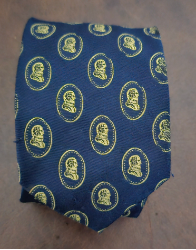
Something that loses its primary function can still retain secondary ones. Neckties no longer are used to keep us warm but they are still useful to convey information. Wearing one signals a serious, conservative, attitude or role; people who work in banks wear ties. You wear one at a funeral or a wedding. They can be used as flags, to signal loyalty or affiliation, a regimental tie or college tie. On the rare occasions when I wear one it is ornamented with busts of Adam Smith. I own, but have never worn, a tie ornamented with dinosaurs, inherited from a geologist father in law.
Libraries are no longer needed to store large numbers of books but a room of children’s books is a convenient place for mothers to bring children to look at books and play with each other. Watches are no longer needed to keep track of time now that everyone has a smart phone in his pocket but they can still keep track of your pulse or count steps, signal you silently that time is up by vibrating against your wrist. A school full of kids may no longer make sense for educating them in a world where they all have access to an internet full of classes and, in the near future, AI teachers who can devote full attention to each student as human teachers with a roomful of kids cannot. But it remains a place where kids can meet each other, make friends. It would work better for that purpose if we did not insist on age segregation; potential friends are not necessarily the same age. Colleges may be becoming obsolete as places to learn but they are an ideal environment for finding a mate and mate search is one of the chief activities of young adults.
Mass lectures may serve some purpose; we still give them more than five hundred years after the invention of the printing press but I don’t know what. A possible guess is that many students can learn by hearing and not by reading, but textbooks can be audiobooks as two of mine are. An alternative guess is that a lecture class is a commitment strategy for someone who would procrastinate on learning from a book until it was too late to do it before the final exam. Neither seems an adequate explanation.
My web page, with the full text of multiple books and articles and much else
Past posts, sorted by topic
A search bar for past posts and much of my other writing
A draft of my next book, Consequences of Climate Change, webbed for comments.
I think one of the difficulties here is that you're probably writing to mostly those who do and have done a lot of self-education. For them, lectures tend to be boring.
I taught for about 30 years in, let's say politely, less selective colleges and universities than our host.
Many of my students appeared, even the bright ones, unaware of even the possibility of self-education. If the materail wasn't put before them in digestible chunks chosen by the professor they had no idea of what to do,
One of my favorite comments on RateYourProfessor was "He assigns this huge text, only covers about half of it in class, gives no study guides, then on the tests expects you to know everything." It was a text to an intoductory course in American Government.
I still wear an analog wrist watch. I’m not interested it getting a smart watch or fitness tracker. My smartphone (which I use far more frequently than I like to admit) sits in my pocket when I’m not using it. My watch is a far more convenient device to know the time than my phone is. It may be an archaic “unitasker” but I like it.