
I believe that global warming is probably real, probably anthropogenic, may well impose net costs1 This raises an obvious question: What, if anything, should we do about it?
If I were dictator of the world and wished to maximize economic efficiency, the answer would be fairly obvious. Impose a tax on activities that create greenhouse gases designed to reflect the marginal cost they create. That is the standard economic solution, due to Pigou, for problems of negative externalities. Since the tax brings in additional revenue, combine it with a corresponding reduction in whatever taxes currently have the largest adverse effects.
I do not, in fact, support carbon taxes. The reason is that I do not believe that, if imposed, they would fit the pattern described above.
To begin with, they would not be based on a realistic estimate of the marginal costs; insofar as they would be based on anything, judging by past arguments over Kyoto and similar proposals, it would be a target level of temperature. If the level of taxes needed to hold warming down to the target level turned out to be much higher than the marginal damage done at that level, as it well might be, we would be buying lower temperature at a price higher than it was worth.
I offer as further evidence the arguments I have had over the years, especially back when I was posting in climate threads on Facebook, with people certain that global warming would have catastrophic consequences but unable to support that conviction with anything more than handwaving arguments. Judging by casual observation, they are the norm, not the outliers, of their movement.
I think it unlikely that income from carbon taxes would be used to reduce other taxes. The clear evidence here is the repeated pattern with regard to wars. New taxes are introduced as an emergency measure for a war, at least some retained long after the war is over; there is always some politically profitable way to spend the money. In the case of carbon taxes, I am confident that they would be used as an additional source of revenue, perhaps with the argument that the additional money was needed to ameliorate the effects of whatever global warming continued to occur.
Finally, I suspect that widespread acceptance of the catastrophist view of global warming would result in more than carbon taxes. It would provide a new justification for politically motivated interference in a wide range of human activities. Anyone who questioned such policies would be labelled a denialist, accused of wanting Bangladeshis to drown and African children to starve. Again, look at the variety of policies that countries have implemented to reduce CO2 emissions and the online arguments.
The fundamental problem is that there are no political institutions that make it in the interest of governments to act in the interest of their citizens: Market failure, the exception on the private market, is the norm on the political market. The reasons have been explored in public choice theory, the project of analyzing the political marketplace with the same assumption we use for the economic marketplace, that individuals act in their own interest.
For an economist, the simplest evidence is the case of tariffs. The relevant economics, the basics of which were worked out more than two hundred years ago, imply that a tariff usually produces net costs for the inhabitants of the country that imposes it. Yet almost all countries had and have tariffs and the pattern of what industries are protected does not fit the special cases that are exceptions to the general rule, does fit the predictions of public choice theory.
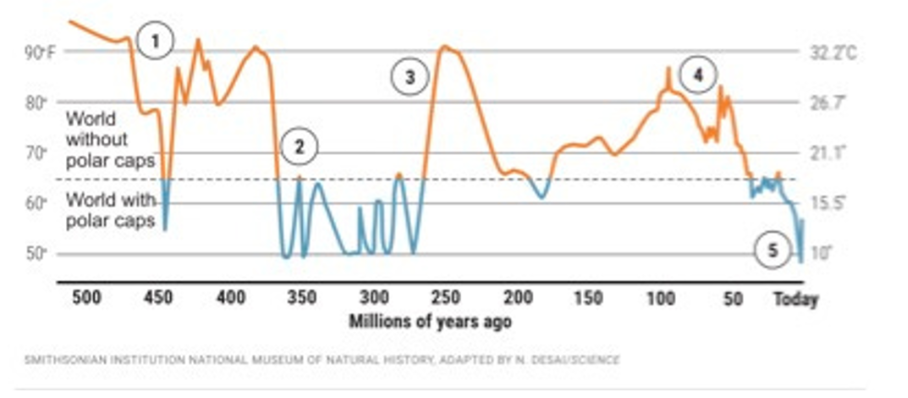
I conclude that serious efforts to combat global warming would have large costs, costs justified only if there were good reason to be confident that not taking such efforts would have catastrophic effects. I see no reason to think that. Current global temperatures are high by the standards of the past two thousand years, low by the standards of the past hundred million.
When I offered these arguments on my blog, Greg Mankiw responded on his. I rebutted by email, eventually put the rebuttal on my blog. That exchange occurred nearly 20 years ago but I do not think the arguments have changed much.
For a book-length account of my position, see the webbed draft of my next book, Consequences of Climate Change.
My web page, with the full text of multiple books and articles and much else
Past posts, sorted by topic
A search bar for past posts and much of my other writing
A draft of my next book, Consequences of Climate Change, webbed for comments. Read it and tell me what I have wrong.
Net because although it will certainly produce costs it will also produce benefits.
I believe climate change is real, that anthropogenic contributions to such are minuscule and we should and will adapt to said changes. Oh, and I'm right and you're wrong David, 'cause I'm older than you!
Of course my last sentence is facetious but I do contend that many, if not the majority of arguments, on either side of the question are at, or approach the same level of absurdity, hence equally invalid.
Since modern humans evolved during a relatively cool time, it seems weirdly optimistic to think that our economy will thrive under Cretaceous conditions.