
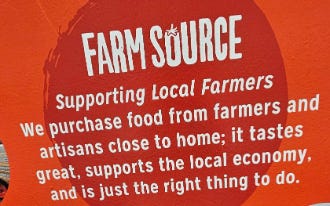
The sign, from an Eat ‘n Park that we sometimes eat at on our Pennsic trip, expresses a common sentiment, that it is virtuous to buy from someone who lives close to you instead of from someone farther away, support the economy of your town instead of that of some other town, that it is “just the right thing to do.”
Why?
Evolutionary Psychology
Evolutionary psychology offers a possible answer. In the environment we evolved in, people living nearer us were, on average, more closely related to us. Biasing my actions in their favor makes them more likely to survive and reproduce. My relatives are more likely than others to have the genes I have so increasing the reproductive success of my kin increases the frequency in later generations of genes I have, including the gene for local altruism.
That might explain the bias but does not justify it. In the modern world, if I want to bias my actions in favor of my relatives I have better ways of doing it than favoring people who happen to live near me. Further and more important, getting copies of my genes into later generations, reproductive success broadly defined, is my genes’ objective, not mine.
Commitment Strategy
In an earlier post, The Economics of Vice and Virtue, I explained features of human behavior as commitment strategies adopted for their effect on how it is in other people’s interest to interact with us. Combine that with the logic of Gary Becker’s theory of altruism, in particular the Rotten Kid Theorem. It is in my interest for people I interact with to believe that I care about their welfare, hence will be unlikely to cheat them, inclined to structure our interaction in ways that benefit them as well as me. That not only makes it easier to interact, it also gives them a reason to act in my interest since the more resources I have the more ability I have to benefit them.
It is easier to convince people that I care about their welfare if it is true — most of us are not very good con men — so I get a benefit from programming myself to care about the welfare of people I interact with. I also get a cost, a reduced ability to structure the interaction to maximize my own benefit. The benefit depends on their interacting with me enough to recognize my commitment strategy, the cost does not. I interact more with people nearer to me and they have more opportunities to observe my interactions with others, so people nearer to me are more likely to recognize a commitment strategy in their favor. Hence it is more likely that it is in my interest to adopt such a strategy with regard to someone the closer he is to me, all else being equal, hence it is in my interest to have the observable characteristic of giving greater weight in my decisions to people closer to me.
Does that justify “is just the right thing to do?” It seems an odd way of saying “is in my interest to do” but, in the earlier post, I described a similar commitment strategy as explaining virtue.
It is at least as close to a justification as I can offer.
Defective Moral Vision
A different explanation was offered by my wife when I put the puzzle to her. Our neighbors, whom we sometimes see, occasionally interact with, are real people. We know in theory that a farmer in the next state, even one on the other side of the Atlantic, is real too but he does not feel real.
Doing good things for real people is just the right thing to do.
The Dark Side
Buying from a nearer supplier, favoring the local economy, may or may not be something to be proud of but it is at worst not very wrong. The moral intuition that people close to you count and other people do not, on the other hand, … .
My web page, with the full text of multiple books and articles and much else
Past posts, sorted by topic
A search bar for past posts and much of my other writing
A draft of my next book, Consequences of Climate Change, webbed for comments.
If the fit hits the shan, enlightened self interest.
Be it zombie apocalypse, WW III or stubbed toe, having those near you thinking well of you due to beneficial interactions and hence, willing to help you surmount is of greater value than the assurance of one 3 time zones away.
I think one of the better arguments for buying things locally is that you want those types of stores and businesses local to you. That is, if you like having farms around you, buying produce from them is a good way to ensure that. If you want game stores near you, you should buy games there. If you want local restaurants, you should eat
there, etc. Too often people complain that there are no X nearby anymore, yet were unwilling to pay for it when it was nearby. Instead they often try to use political means to e.g. ban development of farmland.
This isn’t exactly a moral argument, just a good reason to buy local along side “it tastes better” or “it supports people I know.” I doubt it helps the local economy much, other than helping to keep businesses of the type you spend money on around.
(At the same time, if the business is bad and you don’t want it around , by all means don’t spend money there!)