
Trip Notes 2
Chile and Argentina
In America the enemies of liberalism stole its name so we stole “libertarian” from the left anarchists as a replacement. In Chile, as in much of the rest of the world, that never happened, so we can still call ourselves liberals. In those countries, so far as I can tell, some call themselves libertarians — Chile has a libertarian party and my hosts have “libertarios” in their name — either to emphasize the connection to the American movement or to signal a more extreme version of liberalism.
I was told that the Libertarian Party of Chile got 14% of the votes in the recent presidential election. That sounds impressive since the best the US Libertarian Party has managed is 3.3 %, but part of the reason is that Chile has its elections in two rounds, with the second round between the two parties that did best in the second round. A libertarian in Chile can vote for the libertarian party in the first round and his preferred major party in the second. A libertarian in America who votes for the LP gives up his chance to vote for one of the major party candidates. That suggests an advantage for the Chilean system: It provides a way in which a minor party can show its strength and by doing so grow into a major party. Argentina has the same system, which may explain how Milei was able to create what is now the strongest party in the country.
Chile currently has an unemployment rate of over nine percent. I was told that among the reasons are an increase in the minimum wage rate and an increase in an employment tax, something like our social security tax but paid entirely by the employer. That those two changes would increase the unemployment rate is not surprising; the interesting part is their interaction.
Our social security tax is paid half by the employer, half by the employee. I have always viewed the division as purely ornamental, believed that the effect of the tax would be exactly the same if it was paid entirely by the employer or entirely by the employee. If I pay you ten dollars and the government takes one dollar of it, it does not matter whether they take the dollar before I pay it or after. Either way I end up paying ten and you end up getting nine.
In the presence of a minimum wage law it does matter. With a ten dollar an hour minimum wage and a one dollar tax paid by the employee, if I hire you for ten dollars an hour you cost me ten dollars an hour and get nine. If the tax is on the employer and I hire you for ten dollars an hour you cost me eleven and get ten. If your work is worth more than ten to me but less than eleven, I hire you in the first case but not the second. So putting the employment tax on the employer, as Chile does, increases the effect of the minimum wage law, pushes unemployment higher than if the tax was on the employee or split between them.
The national drink, but not exactly a drink, of Chile is the Mote con Huesillo. The mote part is cooked, husked grains of wheat. The huesillo is a dried peach cooked in water, sugar (slightly caramelized according to my local informant) and cinnamon. The grains end up at the bottom of the glass along with the rehydrated peach, both eaten after the liquid has been drunk. Quite tasty. I dry our peaches in slices or as peach leather, do not know how hard it would be to dry a whole peach.
Our peaches will be coming ripe soon.
I chatted in the plane to Buenos Aires with a woman from Argentina who told me that Millei was crazy and crazy was what Argentina needed. I told that story to some Millei supporters. They agreed.
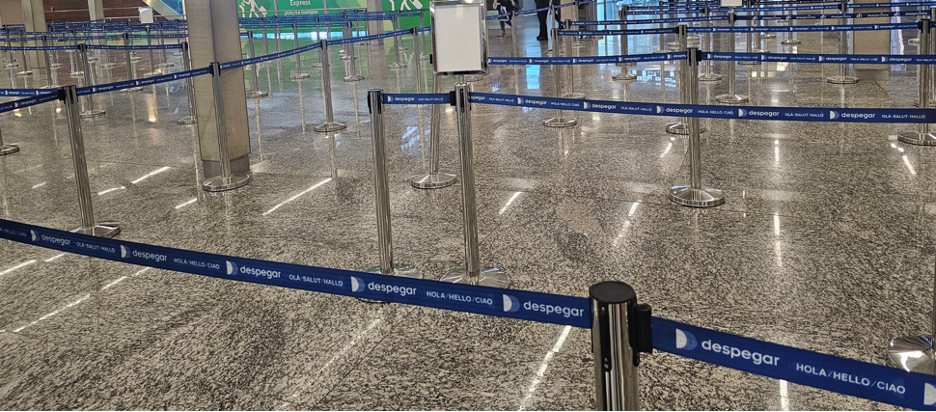
The airport in Buenos Aires has the usual large room where arriving passengers have their passports checked. There was the usual barrier intended to form hundreds of passengers into a zigzag line. I believe it is the only such room, possibly the only such zigzag barrier I have seen where, when there were ten or twenty in the line rather then hundreds, someone had the sense to open gaps in the barrier to let people go straight.
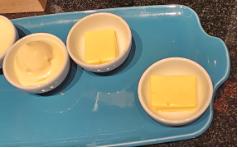
My first breakfast in Buenos Aires provided another example of sensible behavior. Restaurants usually serve butter at refrigerator temperature, which looks nice but doesn’t spread. The breakfast buffet at the HN Lancaster hotel, of which I will write more below, has it at room temperature.
Those are two small ways in which people in Argentina appear to be more sensible than most.
The elevator in my hotel requires a room card to go up, a common security precaution, but also to go down, a requirement that serves no purpose I can think of. The turnstile controlling entrance to the university where I gave a talk requires a university ID card not only to go in but also to go out. It is the same mistake in two different dimensions, one vertical, one horizontal.
Score so far: two plus, two minus.
In Buenos Aires, local streets separate the part for driving from the part for walking more effectively than they do where I live.
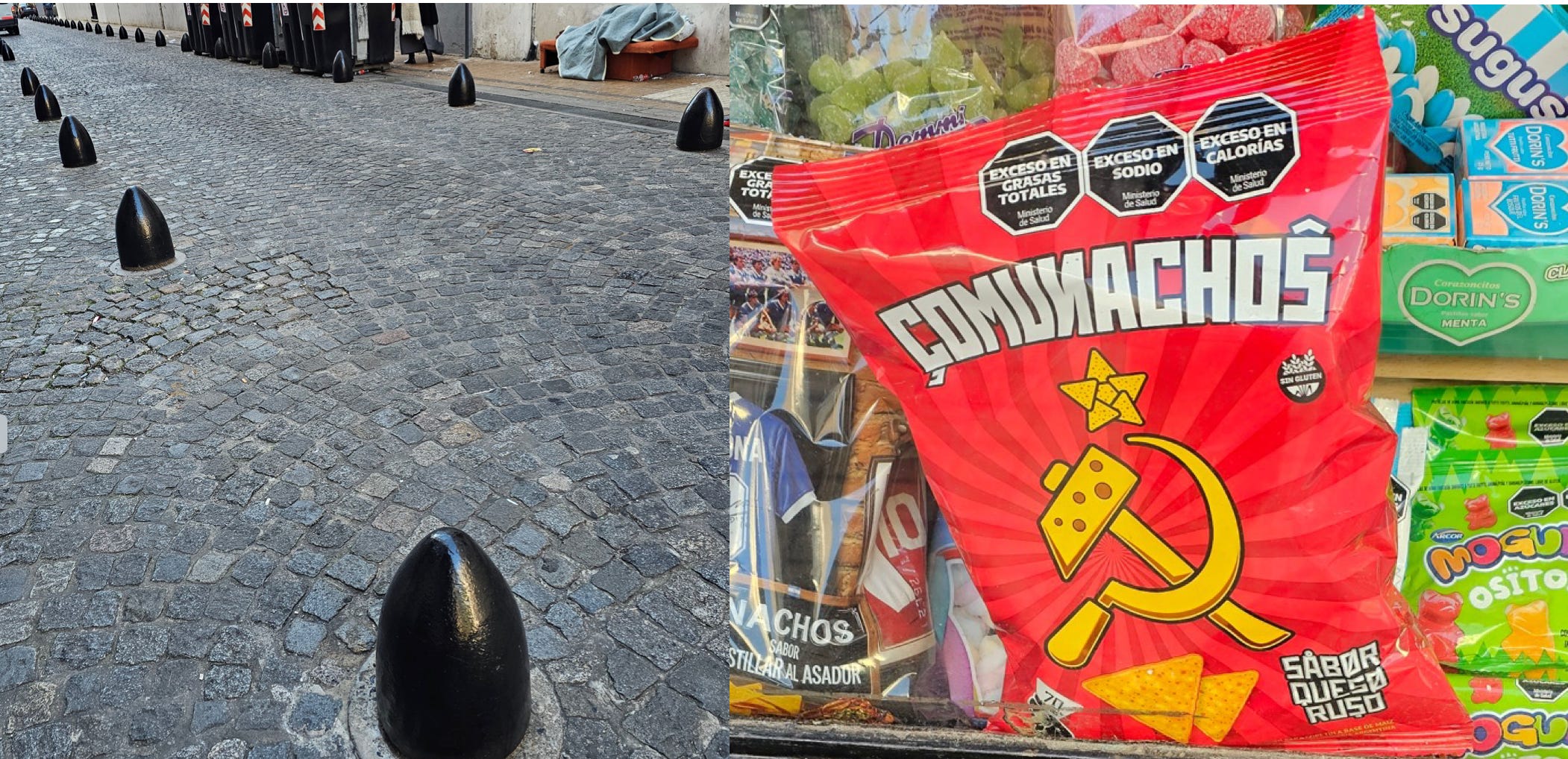
In Argentina even the Nachos are political.
The breakfast buffet in Santiago was good by American standards but not up to the level of the best European hotels. The one in Buenos Aires, on the other hand …
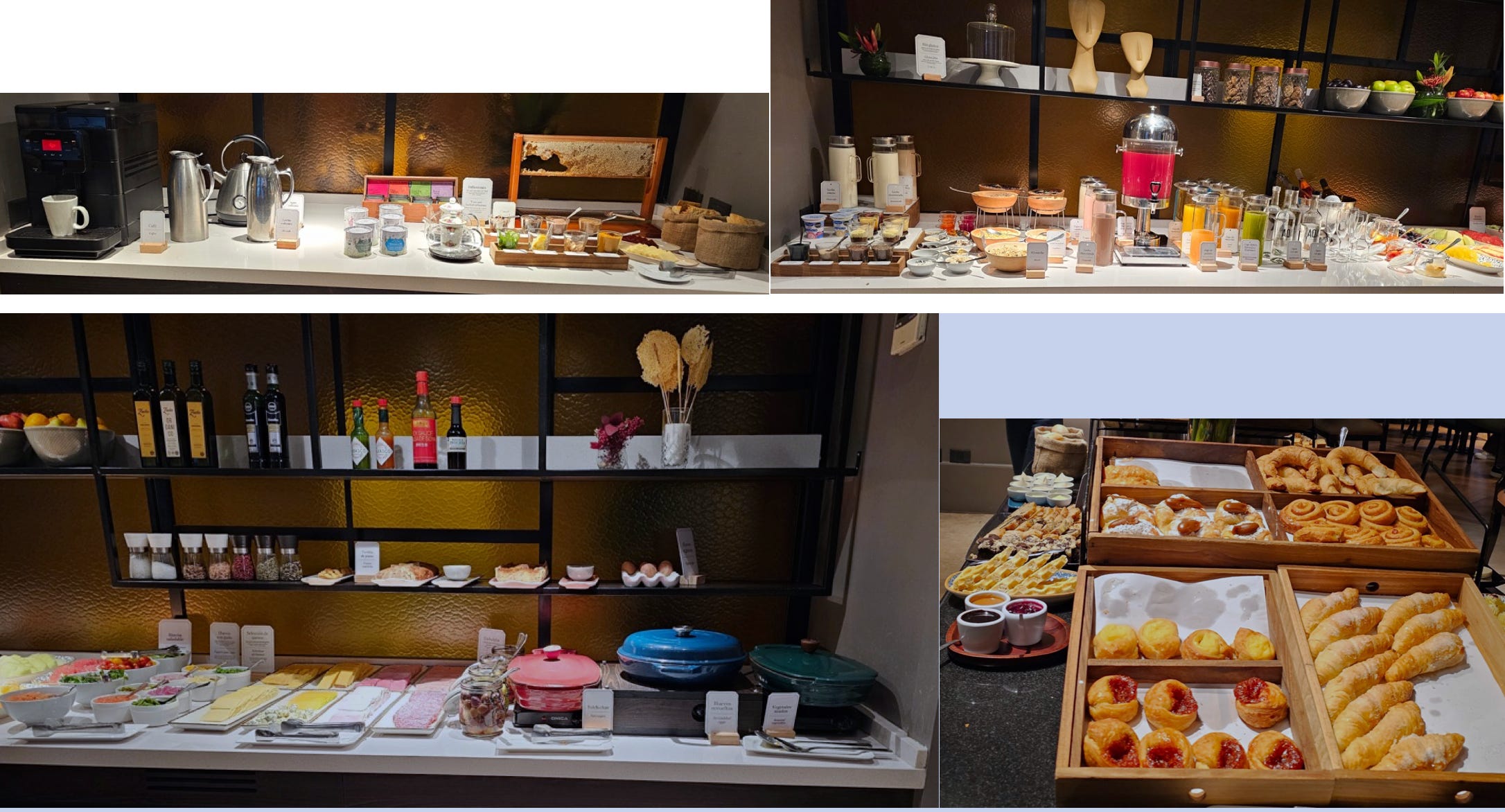
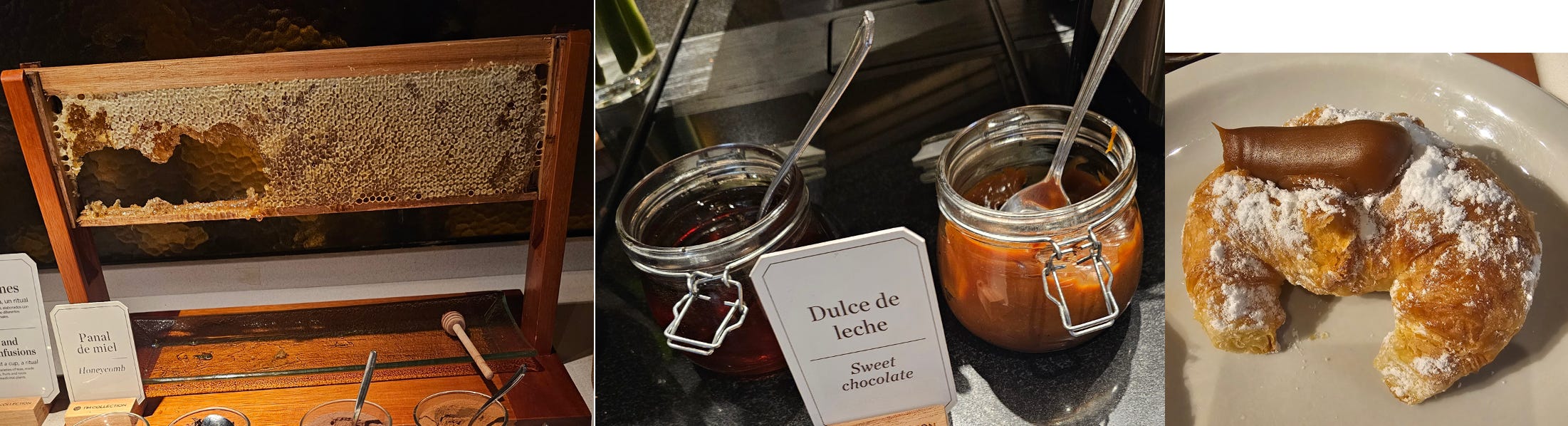
The Argentines like sweets. The breakfast buffet is largely deserts; scrambled egg and sausage are squeezed down to pots at the end, so unobtrusive that I only discovered them the second morning. It is the only one I can remember with honeycomb as well as honey (see below). The honey is next to Dulce de Leche, a sweet spread offered in multiple forms, at every meal and with almost everything. A croissant is sprinkled with powdered sugar; in case that is not sweet enough there is a dab of Dulce on top. They eat four meals a day, the extra between lunch and (very late) dinner, their equivalent of the English tea but with pastries instead of tea and sandwiches.
Concerning “Marmalade”
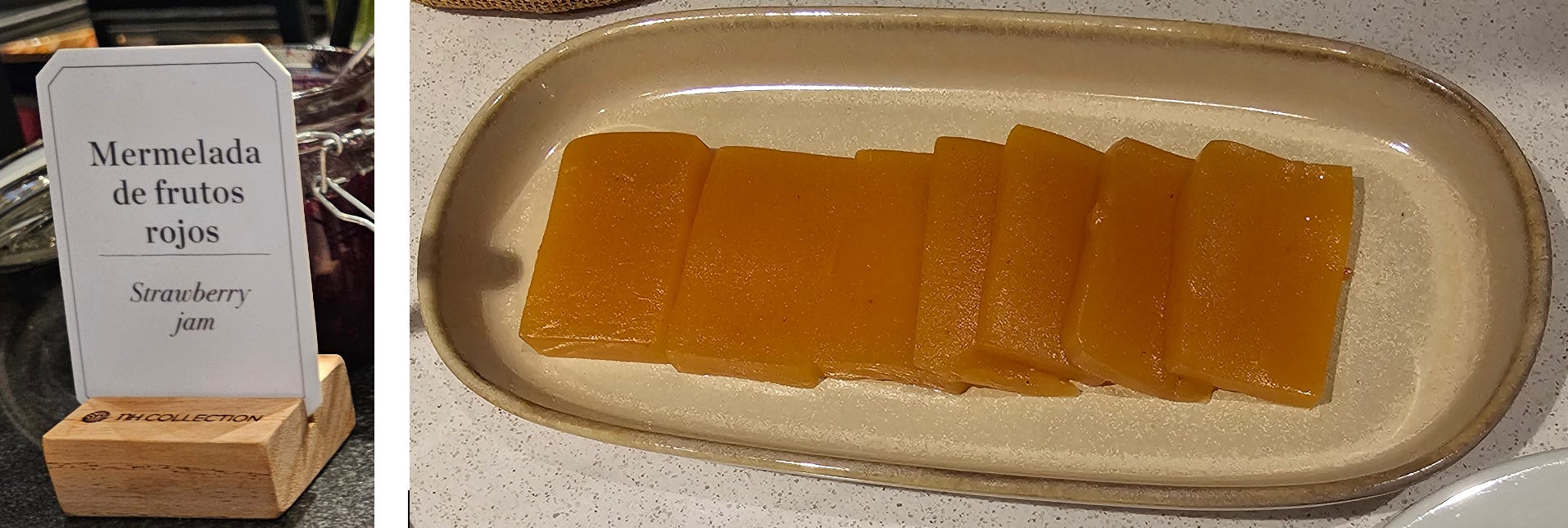
The original meaning of “Marmalade” was quince preserves, possibly quince paste, exported from Portugal where the word for quince is “Marmela.” In the US marmalade is a jam made with citrus, in Argentina any kind of jam. Browsing the breakfast buffet I noticed an unlabeled stack of what looked very much like rectangles of quince paste, something I had made from a recipe published in England at the beginning of the Seventeenth Century. It was indeed dulce de membrillo1 — quince paste. Later that day I noticed quinces in a grocery store, something you would almost never see in the U.S.2 The price came to about a dollar a pound, clearly not an exotic luxury. I am writing this in the plane flying home; my checked luggage contains a membrillo pie, a gift from one of the Argentine libertarians.
The quinces on my tree should be coming ripe in about three months.
Showers
There are three desiderata for hotel showers:
1. A sprayer that you can hold in your hand or attach to a vertical pipe as a second shower head of adjustable height. Positioning it to spray the wall lets you adjust the water temperature without getting scorched or frozen.
2. Rapid response of water temperature to the control.
3. Water temperature that, once adjusted, is stable.
The NH Lancaster in Buenos Aires had all three. My hotel in Santiago had the first two but the water temperature, once adjusted, occasionally had fits of alternating between too hot and too cold. It seemed to happen less if I showered early, which made me suspect that it might be due to the effect of other guests taking showers.
The Hilton in Montevideo did not have the first, although it did have an enclosure large enough to make it possible to adjust the shower temperature while not under the shower. It lacked either the second or the third, I am not sure which; one night did not provide enough data to tell whether the problem was variable water temperature or the slow response of the temperature to the controls leading me to repeatedly over-compensate.
In about another fifteen hours I will be home.
My web page, with the full text of multiple books and articles and much else
Past posts, sorted by topic
A search bar for past posts and much of my other writing
A draft of my next book, Consequences of Climate Change, webbed for comments.
I do not know why Spanish and Portuguese have entirely different words for quince but the difference is old; I have a recipe for Buen Membrillate Que Es Potaje De Membrillos from a 16th century Spanish cookbook.
Except in the Berkeley Bowl, which has everything.
It is very important for us here in Latin America to receive the distinguished visit of an authority such as yourself, David Friedman. Indeed, around here we use the term "liberals" to describe individuals who adhere to liberalism—whether in its more classical or minarchist branches. I observe that those who identify as liberals in our region often blend different schools of thought: from Adam Smith, through representatives of the Austrian School of Economics, and, of course, the Chicago School and your prestigious father, whose work remains mandatory reading here. On the other hand, "libertarians," although drinking to some extent from the same fountain as minarchist liberals, lean closer to anarcho-capitalism.
However, despite the growth of these doctrines in the political debate, the overwhelming majority of Latin Americans remain tied to the current of "social democracy," if not radical socialism. These trends stay alive in Latin American politics due to a defining factor: the collectivist and statist mindset of the people in general. The local citizen tends to view the State as a "benevolent father," always ready to "shelter" the needy and "guide" the nation toward a supposedly higher moral and civilizational standard of "dignity."
This serves as a warning to the disappointment of those who advocate for this interventionist, regulatory, centralized, and provider State: unlike countries that truly possess a market economy grounded in economic and individual freedom, once the State turns into a monster—a Leviathan—it hardly ever agrees to step back. I say this from firsthand experience.
Requiring a room card to go down as well as up in a hotel likely improves security.
Opportunistically sneaking up by following legitimate guests would be possible, having done so, the need to use a card to go down would make getting away with stolen property more difficult.
For a single person turnstile, this seems much less relevant.