
Leslie Fish
It was dark of the first night of my Pennsic bardic circle this year, people sitting around a fire entertaining each other. Someone came in, sat down, started to play something on a guitar. For a moment I thought it was Leslie, long a regular at the circle.
It was Morgan, the other guitar player among my regulars. Not even Leslie could show up at my circle eight months after she died.
Every Pennsic they burn a longship carrying shields painted with the devices of those who have died during the year. Leslie had no device but I could paint a fish, with luck a fish with a guitar. When I got to where the shields were being painted Morgan was there and offered to do it for me.
Morgan is a much better artist than I am.
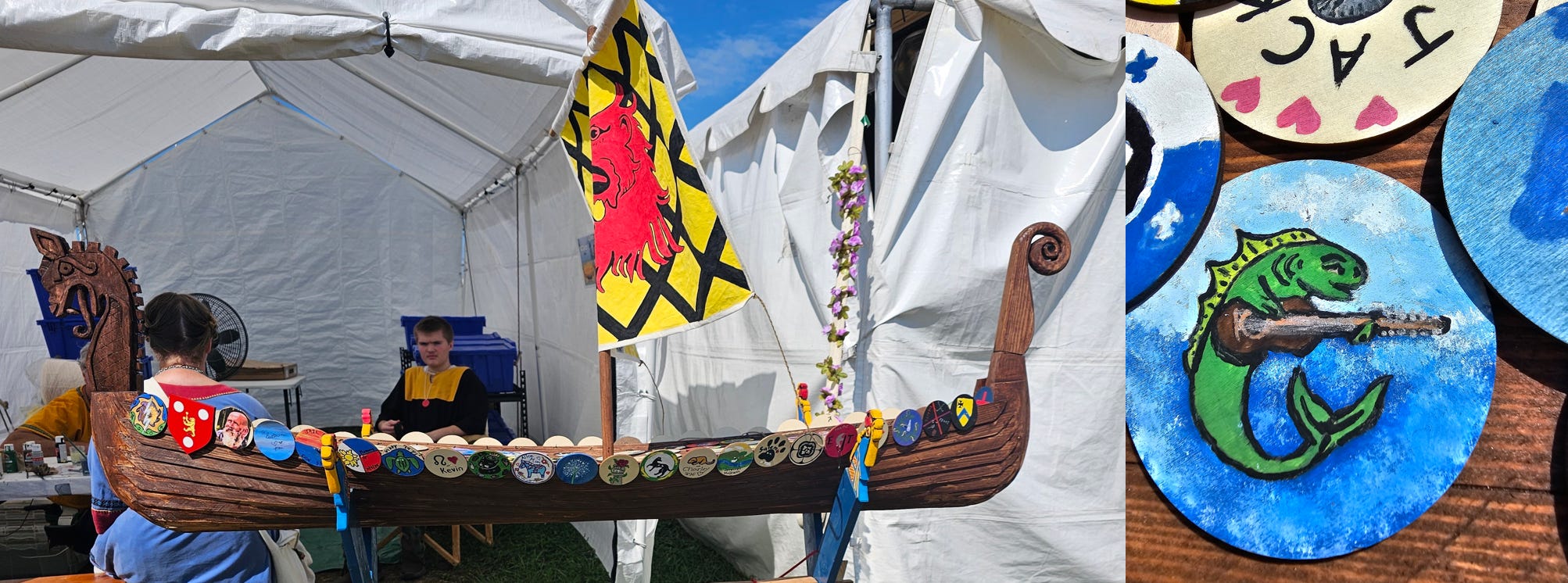
I first met Leslie and her partner Mary more than fifty years ago. I was a graduate student at the University of Chicago, a libertarian anarchist, on the right insofar as the right/left classification applied to libertarians. They were folk singers, political activists, Wobblies, members of an IWW band, left anarchists insofar as … . We shared a fondness for Kipling’s poetry, much of which they had set to music, felt more like allies than enemies.
I didn’t know then that she’d been present at the infancy of the modern libertarian movement, at that strange time when two tribes that by conventional reckoning shouldn’t have existed at all—an antiwar wing of the conservative Young Americans for Freedom and a free-market contingent in the leftist Students for a Democratic Society — somehow emerged and then combined to form something new.
…
She wasn’t exactly a libertarian—not the capitalist kind, anyway—but she had the same unwillingness to fit into any ordinary political pigeonhole. Discuss the family or the workplace, and she’d stake out a position well to the left of even Ann Arbor’s mainstream. But if the talk turned to taxes or guns, she wouldn’t be out of place at a militia meeting. (“American Anarchist, The life of Mary Frohman,” Jesse Walker, Reason).
The best portrait of Leslie I can find is by her, an autobiographical letter parts of which are webbed. Here are some pieces of it.
My current filk-book has over 100 songs in it (I haven’t counted), and there’s my Kipling collection (at least another 50), my Pagan songs (at least 25 there) all the Misty Lackey poems I put tunes to that I don’t have copies of (another 25 or so), plus some purely folkie-political stuff I have in other books at home. Say at least 200, maybe 300 -- and I’m constantly adding to it, so I have no way to tell.
…
Cats
... it started off as a college Psychology project, and just sort of grew from there. A neighbor had a female “domestic shorthair” (i.e.”alley”) cat who got herself merrily knocked up by a purebred Siamese tom, and now had kittens to give away. I noticed that two black kittens in the litter (fortunately a male and a female) had unusually long and deep skulls. I adopted the kittens, raised them, played games with them to stimulate their intelligence, tested them (found nice high kitty IQs, too, which got me a good grade for my Psy. term project), and finally bred them. After that I kept on testing, selecting and breeding subsequent generations of kittens for 1) intelligence, 2) disease-resistance, 3) elegant body-types -- in that order of priority. Well, it worked; I now have a line of “purebred” cats with reliably high intelligence, pretty good disease-resistance, and handsome looks. The experiment showed me some things about the nature of intelligence which the official psychologists still haven’t figured out, much to my amusement.
First, increased skull and brain size/capacity doesn’t automatically guarantee intelligence; they just set up favorable conditions for it. Second, increased intelligence requires a high-protein diet and lots of sensory stimulation from birth (pet, cuddle and play with kittens -- or any mammalian babies -- from the day they’re born, and they turn out smart. Simple!).
…
Sports
Okay, I’m weird. I like horsebackriding (pretty good at it, if I say so myself -- more stories there), canoeing, archery, hunting and target-shooting -- but only to DO, not to watch. To me, the whole point of a sport is to enjoy the physical effort, skill and excitement of doing it. I honestly can’t see the fun of watching a gang of uniformed pros running around doing all the action while you just sit on a bench (or TV chair) and watch.
...
Jobs
“Odd jobs”? Heh-heh! Hell yes, I’ve had some VERY odd jobs! Back in my last days in college, I needed supplemental jobs to keep my nose above water. I took whatever jobs showed up in that primarily-college town (Ann Arbor; I went to the University of Michigan), and some of them were odd indeed. I worked as a keypuncher for a Fortran class (remember that antique?), and sneaked revolutionary comments into the interstices -- started off some fine discussions and arguments, too. I did the usual clerking and waitressing too, but couldn’t stand to keep at it for long. I did industrial day-labor too (which inspired me both to join the Wobblies and to write “Minnie the Freak” -- remind me to tell you about that one some time). Having developed a taste for bizarre work, I kept at it after I finished college and moved to Chicago. I worked for awhile as yard-clerk (”cinder kicker”) for the B&O Railroad. I was under-editor for the Wobblies’ newspaper, THE INDUSTRIAL WORKER, for a year. I also put together the IWW union band, The Dehorn Crew, which managed to get a little work around Chicago, but which is mostly famous for doing an album of my StarTrek songs called “Folksongs For Folks Who Ain’t Even Been Yet”, which sold at SF cons well enough to inspire another album called “Solar Sailors”, which brought me to the attention of Off Centaur Publications, who invited me to come move out to California and work for them as their house musician. Wierd enough yet?
…
Learning to read
I learned how to read when I was three. Mom had a habit of reading me bedtime stories, and I soon noted that the same stories from the same books always used the exact same words -- very different from the stories Pop told me, which he made up himself. (They tried all sorts of tricks to make me go to sleep on time; none of them worked, but I learned from all of them.) I would sneak closer and peek into the book to see what it was that showed Mom the same exact words, and I noticed lines of regular, repeating squiggles that were obviously The Secret Code. I asked Mom about the squiggles, and she was delighted to show me what letters were and how they worked.
…
Political Activism
Michigan was far enough from home to keep the parents from visiting regularly, or expecting me to come back every weekend). My first day there, after the parents had left, I strolled around the campus getting acclimatized when I saw a poster announcing a pro-Civil Rights demonstration that night. I took my guitar and my folkmusic books and showed up.
It was quiet, peaceable, and dead-boring as picket-lines go, and between songs I had plenty of time to talk to the picket-captain. He was a grad-student named Tom Hayden, and he was one of the founders of this pro-civil-rights/anti-war group called Students for a Democratic Society, and how would I like to come see what they were up to? “Where do I sign up?”, said I.Needless to add, I spent the next few years running around doing pro-civil-rights and anti-war stuff when I wasn’t studying, doing folkmusic or trying to earn money.
…
SF and Filking
The show was STAR TREK, and I walked in on the beginning of “Mark of Gideon” -- a good episode if not a great one, about the horrors of overpopulation. Well, I was hooked. Ye gods, a TV drama-series that dared to talk about real issues -- such as overpopulation, war, censorship, sex -- all the things that so-called serious TV wouldn’t dare touch, and it was science-fiction yet! …
…
In 1982 I got a contact from Off Centaur Publications, the first people to seriously make a full-time business out of recording and selling filk; seems they were putting together a new kind of convention (Bayfilk) and wanted to invite me as their next guest of honor. Well, I’d never been to a purely-filk con, or to California, so naturally I went. (I wrote “No High Ground” while waiting in the airport -- one of the last times I rode a plane -- sang it at my opening concert and had an instant hit on my hands.) It was great fun, and San Francisco was the most physically beautiful city I’d ever seen, and the weather was utterly gorgeous (especially compared to Chicago; ask me about the Bad Winter of ‘79 sometime -- that’s when 15 feet of snow fell on the city between New Year’s and April Fool’s, and it didn’t all melt off until Mayday. Tales I could tell...). So, after the con was over (and after I’d spent a few days recording some of my Kipling songs for what later became COLD IRON), when Teri Lee asked me: “Why don’t you move out here and work for us?” all I said was: “Wait ‘til I pack.”
So, (after a few delays, such as attending the first Trek-fan writers’ con in Britain, selling or rail-shipping everything I owned, formally breaking up the band, booting out a dead-beat roommate, and getting my car fixed up for the trip) I took off cross-country for the San Francisco Bay. That trip was an epic in itself, since it was a cold and snowy February, and there was a truckers’ strike going hot and heavy -- complete with State Trooper raids and shooting rifles at scab trucks, and the convoy of fans I linked up with had vehicles in worse shape than mine, and a lot of the highways were closed off with snow (don’t ever get snowbound in Amarillo; the city has absolutely no facilities for it).
…
Using the skills I’d picked up while writing for ST fanzines (seeing how much feedback you get per story, I’d say there’s no better working school for writers), I started sending out my fiction in search of a buyer. I sold just one story (”Amateurs”, a little realistic horror piece, to the short-lived NIGHT CRY, for the unimpressive sum of $75.00) when I ran into C.J. Cherryh.
Okay, I’ll tell you that story. It was at a WesterCon, I think (after too many cons they begin to blend together), and I was pretty much leading the Bardic Circle in the smokers’ room, when a shy-looking lady in a subdued business skirt-suit tiptoed into the room and took a seat at the far end of the circle. She was carrying an electric autoharp, which is, to be blunt, a piss-poor instrument. In short, she looked the perfect picture of Neo. Well, be nice to Neos, I always say; remember, thou too wert a Neo once.
Well, when it came her turn, the shy little lady pulled out her autoharp and sang a long, slow, quavery, almost-tuneless ballad in such a tiny, shy little voice that I couldn’t make out the words from less than ten feet away. Everybody else was yawning, shuffling through their filk-books for next choices, getting up to make a quick trip to the john, etc. Me, I stayed put and did my best to look intently interested in the Neo’s song (remember, thou too...).
When she’d finished, since I couldn’t think of anything else encouraging, I praised her choice of song and asked, as gallantly as I could manage, “Did you write it?” She blushed, smiled, nodded, then packed up her autoharp and scurried off while the next song started up. Little seen, little heard, soon forgotten. Until next day, when I strolled down to the dealers’ room to see how OCP’s sales were doing. At the table, I found Teri bouncing up and down with excitement, waving frantically the minute she saw me. It seems that Hugo-award winner C.J. Cherryh had come up to the table an hour before, bought over $100 worth of books and tapes -- particularly my stuff -- and she wanted to meet me at 2PM, table 4, in the hotel lounge upstairs. Wow.
Of course, at 2PM I showed up at the hotel lounge and went looking for table 4. Guess who I found sitting there, nursing a double dark-rum cooler? Uhuh. Not exactly a Neo: just new to filking.
…
Anarchy
What sort of anarchist future would I like to see? There’s no reason for a government-free society to be nothing but agrarian, no reason at all that it couldn’t be industrial and space-faring. Anarchism is purely a political theory, holding that “power” -- the ability to force others to do you will -- is the root of all evil. Money is merely a useful shorthand for things-done or things-made, and is completely neutral; you can use it to buy food or buy a law. Money’s a useful thing, and I think the poor should have more of it (hell, I should have more of it!). Power, on the other hand, is something nobody should have -- except the power to get the other guy’s foot off your neck and hand out of your pocket.
So what I hope to see is a society that’s free, knowledgeable, and can bootstrap itself into space as fast as possible. This planet is desperately overcrowded and overexploited (if you doubt that, look at Africa; the reason for the recent rash of famines is that the continent’s population has doubled in the last 30 years, and there’s not enough water or farmable land to feed that many people). The only humane solutions to those two problems are massive birth-control now and mass cheap-stardrive emigration as soon as we can do it. I fear the alternative, because I see it coming.
Prediction: there will be massive economic, political and social collapse around the year 2000, which will cause the killing off of horrendous numbers of people and do gods-know what damage to our already overstrained environment. I don’t think the collapse itself can be prevented, but maybe its effects can be made milder with enough education and planning. As to just what I’m doing on that score, more later.
That prediction was wrong, as was the widely accepted overpopulation scare it was based on. Leslie asserted it with her usual confidence — as an argument for space flight.
As to what a free society would be like, nobody knows for sure because it’s been so long since anyone did it on a large scale, and accounts of the small-scale attempts are hard to come by. … but even those give only a partial picture. All those societies were infected by personal and cultural habits of power-submission, surrounded by law-loving enemies and “reformers” who limited their capacities and ultimately did them in. They left intriguing hints of justice, internal peace, lack of bigotry, prosperity, and flowering of the arts and sciences -- enough to make the experiment well worth repeating -- but just what a totally free society would evolve into over the long run, nobody really knows. It would be fun to see though, wouldn’t it?
A few of Leslie’s songs
SCA
Serious Steel (Bringing the War Home)
SF
Political
An interview with Leslie.
“The Union Man,” SF and political, starts at 6:50 and ends with the Enterprise unionized.
Kipling
"... a free-market contingent in the leftist Students for a Democratic Society ... ."
Free market, and free speech, too. I thought I saw something similar in parts of the left ca. 1970. Alas, it was not to be.
Comparing then to now reminds me of Marx's quip: History repeats, first as tragedy, then as farce.
The cover of Kipling's "Cold Iron" was always my favourite song of hers.
A real shame she passed away \: